

Big Arenh
RTE documentation
The RTE documentation is available here.
What this API collects
ARENH allocation curves for a delivery point, from two distinct endpoints:
- PTS, for the points connected to the public transmission network;
- PDS, for the points connected to the public distribution network.
The two endpoints do not return the same shape of data, and they therefore do not produce the same key.
Insights configuration
Source
Create one source per EIC, as described in Source configuration.
| Property | Value |
|---|---|
| Source type | Rte |
| Meter number | The EIC code |
Variables
| Property | Value |
|---|---|
| Name | Free text |
| Variable type | Basic |
| Mapping config | See Mapping config |
| Granularity | 30 minutes |
| Quantity type | Instant |
| Unit | Megawatt (MW) |
Mapping config
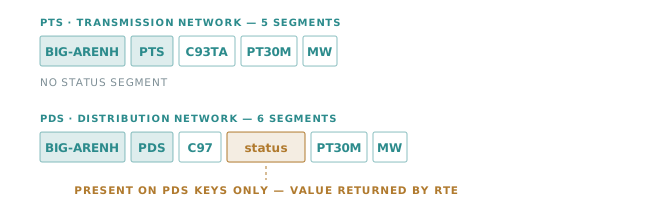
There are two layouts, one per endpoint. The second segment names the endpoint and also decides which endpoint the variable is collected from.
BIG-ARENH_PTS_{dataType}_{resolution}_{unitName}
BIG-ARENH_PDS_{dataType}_{status}_{resolution}_{unitName}
Warning
The second segment must be exactly PTS or PDS. A variable is selected for the transmission endpoint
because its key contains _PTS_, and for the distribution endpoint because it contains _PDS_. Any other
value — a network code such as RPT or RPD, for instance — is never collected at all.
Important
PDS keys carry an extra {status} segment between the data type and the resolution. PTS keys do not. A
PDS key written with five segments never matches.
{dataType} — PTS, transmission network
| Value | Meaning |
|---|---|
C93TA |
Metered consumption curve |
C96TA |
Surplus energy curve, RE-Site RPT non-balanced entities |
{dataType} — PDS, distribution network
| Value | Meaning |
|---|---|
C97 |
Metered consumption curve of profiled points |
C93 |
Metered consumption curve of remotely read points |
C92 |
ARENH calibration coefficient |
C96 |
Surplus energy curve, Site RPD non-balanced entities |
{status} — PDS only
The value published by RTE alongside each point of a distribution curve. Values are split by status, so one curve can feed several variables.
Tip
Rather than guessing this segment, run the collection once and read the log: the message There is no variable with MappingConfig = '…' contains the complete key, status included. Create the variable with that exact value.
{resolution}
| Value | Meaning |
|---|---|
PT30M |
30 minutes — both endpoints are always queried at this resolution |
{unitName}
| Value | Meaning |
|---|---|
MW |
Megawatt |
Note
This segment is copied from the response without any change of case. If a key built from the log shows a different case, reproduce it as it appears.
Examples
BIG-ARENH_PTS_C93TA_PT30M_MW
BIG-ARENH_PDS_C97_{status}_PT30M_MW
The PTS key above is complete and can be used as is. The PDS one is a shape: replace {status} with the
value read from the log for your own point.
Collection schedule
Once a day, at 07:30 UTC.
Recovery behaviour
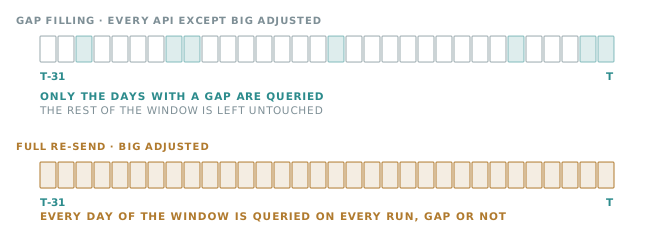
Gap filling over the last 31 days, applied separately to the PTS and the PDS variables of the source: a day
is queried on an endpoint only when one of that endpoint's variables has no data for it.
Perimeter check
The delivery point is looked up in the referential under the api label Big Arenh before any call is made. A
point outside the perimeter is skipped, with the reason written to the log — see
Id Referential.