

Id Referential (V2)
RTE documentation
The RTE documentation is available here.
What this API is for
Id Referential is a discovery API. It returns the perimeter your partner account is allowed to see: which delivery points exist, over which periods, and which RTE APIs each of them exposes.
It is the entry point of any RTE configuration, for two reasons:
- it tells you whether an EIC is inside your perimeter at all;
- it decides, for four of the collections, whether a call to RTE is even attempted.
Note
This API never writes a data point. It is an eligibility and inventory tool only.
What the referential contains
The response is a tree. Each service point carries the data services granted on it, and each data service carries the concrete APIs it exposes.
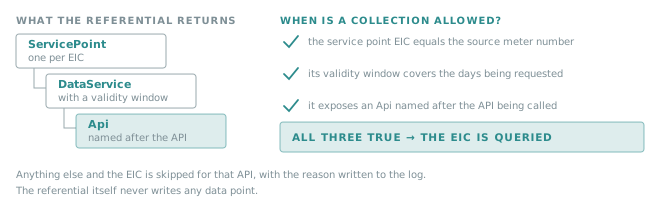
- ServicePoint — a point known to RTE, identified by its EIC code.
- DataService — a family of services granted on that point, valid over an explicit period.
- Api — a concrete API exposed by that data service, identified by a label such as
Big Physical.
Eligibility rules
Before collecting, Big Adjusted, Big Physical, Speed Physical and Big Arenh look the point up in the referential. The point is queried only when the three following conditions hold at once:
- a service point exists whose EIC code equals the Meter number of the Insights source;
- one of its data services is valid over the whole period being requested — its validity window must start before the oldest day requested and end after the most recent one;
- that same data service exposes an Api whose label matches the API being collected.
The labels used for the match are listed in Perimeter check.
Important
Condition 2 applies to the whole recovery window, which is 31 days long. A data service that only became valid a few days ago makes the point ineligible for the entire window, and therefore blocks the collection even for today. This is the usual explanation for a point that is visibly granted at RTE and still collects nothing.
Tip
The other three APIs — Big Bre Reconstitution, Big Imbalance and PEB — do not perform this check. They call RTE directly, so an ineligible point returns an empty response rather than a skip in the log.
Insights configuration
Create one source per EIC, as described in Source configuration. The Meter number is what the referential is matched against.
No variable is needed: nothing is written.
When it runs
There is no schedule for the inventory. It runs:
- on demand, when you ask for the perimeter of your sources to be listed;
- implicitly, before every collection of the four APIs listed above.
Reading the logs
| Message | Meaning |
|---|---|
| Retrieved N service points for source Id(x), MeterNumber('EIC') | The inventory succeeded. N counts the APIs discovered in the referential, not the service points — read it as "N APIs are visible". |
| Service point not found for EIC | No service point in the referential carries that EIC. Check the Meter number, then the perimeter granted by RTE. |
| Api Label 'X' not found for EIC for Period From … To … | The point exists, but no data service exposing X is valid over that whole period. See the note on condition 2 above. |
| Call to IdReferential.V2 failed … Reason: … | The call itself failed: credentials, certificate, or RTE availability. |
Tip
Run the inventory before configuring any collection, and again whenever a point stops producing data. A service appearing or disappearing on the RTE side shows up here first.