

PEB — Block exchange programmes
RTE documentation
PEB is published on the RTE secure applications portal:
https://secure-apps.iservices.rte-france.com/.
Important
Unlike the other RTE APIs, PEB authenticates with a client certificate (mutual TLS) and not with an OAuth2 token. The certificate has to be installed and valid on the Insights side, otherwise every PEB call fails while the other RTE collections keep working normally.
What this API collects
Bilateral block exchange programmes, through two endpoints that feed two distinct families of variables:
| Endpoint | Variable prefix | Content |
|---|---|---|
| Supplier data | PEB_ |
Exchanged volumes per counterparty, as a JSON response |
| Status request | PEB-STATUS_ |
Confirmed block schedules, as a Confirmation_MarketDocument XML response |
The two families are configured independently: a source can hold either, or both.
Insights configuration
Source
Create one source per EIC, as described in Source configuration. The Meter number is also what decides the direction of each exchange — see {direction}.
| Property | Value |
|---|---|
| Source type | Rte |
| Meter number | The EIC code |
Supplier data variables
| Property | Value |
|---|---|
| Name | Free text |
| Variable type | Basic |
| Mapping config | See below |
| Granularity | 30 minutes |
| Quantity type | Instant |
| Unit | Megawatt (MW) |
PEB_{settlementCode}_{counterpartyEicCode}_{resolution}_{unitName}
{settlementCode}
The BRP perimeter settlement code returned by RTE.
| Value | Meaning |
|---|---|
Z44 |
BRP perimeter Z44 |
Z48 |
BRP perimeter Z48 |
Note
When RTE does not provide the code, the segment is left empty and the key contains two consecutive
underscores, as in PEB__17X0000009927499_PT30M_MW. Reproduce it exactly if that is the key the log reports.
{counterpartyEicCode}
The EIC code of the counterparty. Each distinct counterparty produces its own variable, so a point trading with three counterparties needs three variables.
{resolution}
| Value | Meaning |
|---|---|
PT30M |
30 minutes |
Note
The Supplier Data endpoint is always queried at PT30M, and the segment is written from the resolution echoed
back by RTE. In the rare case where the response carries no resolution at all, the key falls back to PT15M —
the log then reports a PT15M key that has no matching variable.
{unitName}
| Value | Meaning |
|---|---|
MW |
Megawatt |
Example
PEB_Z44_17X0000009927499_PT30M_MW
Status request variables
| Property | Value |
|---|---|
| Name | Free text |
| Variable type | Basic |
| Mapping config | See below |
| Granularity | 15 minutes, or 30 minutes when the document carries that resolution |
| Quantity type | Instant |
| Unit | Megawatt (MW) |
PEB-STATUS_{processType}_{businessType}_{direction}_{counterpartyEicCode}_{resolution}_{unitName}
{processType}
Read from the XML response.
| Value | Meaning |
|---|---|
A01 |
Day-ahead schedule |
A18 |
Intraday schedule |
Important
Scheduled collections request the day-ahead process only, so they produce A01 keys. A18 keys are only
filled by an explicit intraday request.
{businessType}
Read per time series in the XML response.
| Value | Meaning |
|---|---|
A02 |
Block exchange schedule |
{direction}
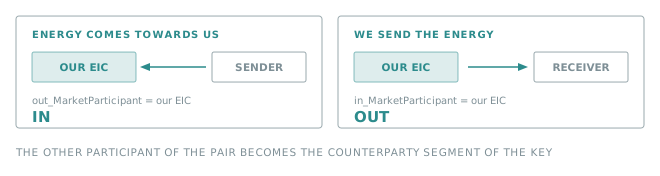
The direction is relative to the EIC of your source: it says whether the energy of that exchange comes towards you or leaves you.
| Value | Meaning |
|---|---|
IN |
Your EIC is the out_MarketParticipant — you receive the energy |
OUT |
Your EIC is the in_MarketParticipant — you send the energy |
Tip
The naming is counter-intuitive on purpose: the XML names the endpoints of the transfer, while the segment
names the flow as seen from your own perimeter. Configure both IN and OUT variables for a counterparty you
trade with in both directions.
{counterpartyEicCode}
The EIC code of the other participant of the exchange.
{resolution}
Read from the period of the XML response.
| Value | Meaning |
|---|---|
PT15M |
15 minutes |
PT30M |
30 minutes |
Note
Scheduled collections request PT15M. A PT30M variable is only filled if RTE returns a period at that
resolution.
{unitName}
Read from measure_Unit.name in the XML response.
| Value | Meaning |
|---|---|
MAW |
Megawatt — the standard value for PEB status documents |
Warning
Status request keys end with MAW, not MW. The two families do not use the same unit code, even though both
carry megawatts.
Example
PEB-STATUS_A01_A02_IN_17X0000009927499_PT15M_MAW
Collection schedule
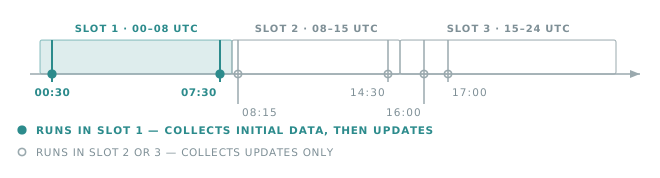
Both families are collected six times a day, in UTC: at 00:30, 07:30, 08:15, 14:30, 16:00 and 17:00.
Note
Unlike Big Adjusted and Big Physical, PEB has no separate initial and updated paths: all six runs behave the same way.
Recovery behaviour
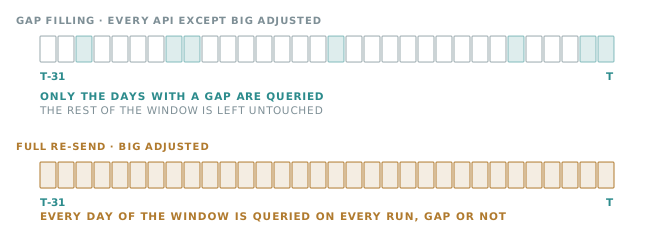
Gap filling over the last 31 days, applied separately to the two families: a day is queried on an endpoint only when one of that family's variables has no data for it.
Perimeter check
This API does not check the referential before calling RTE. A point outside the perimeter returns an empty response rather than a skip in the log. Use Id Referential to confirm eligibility when a source stays empty.